
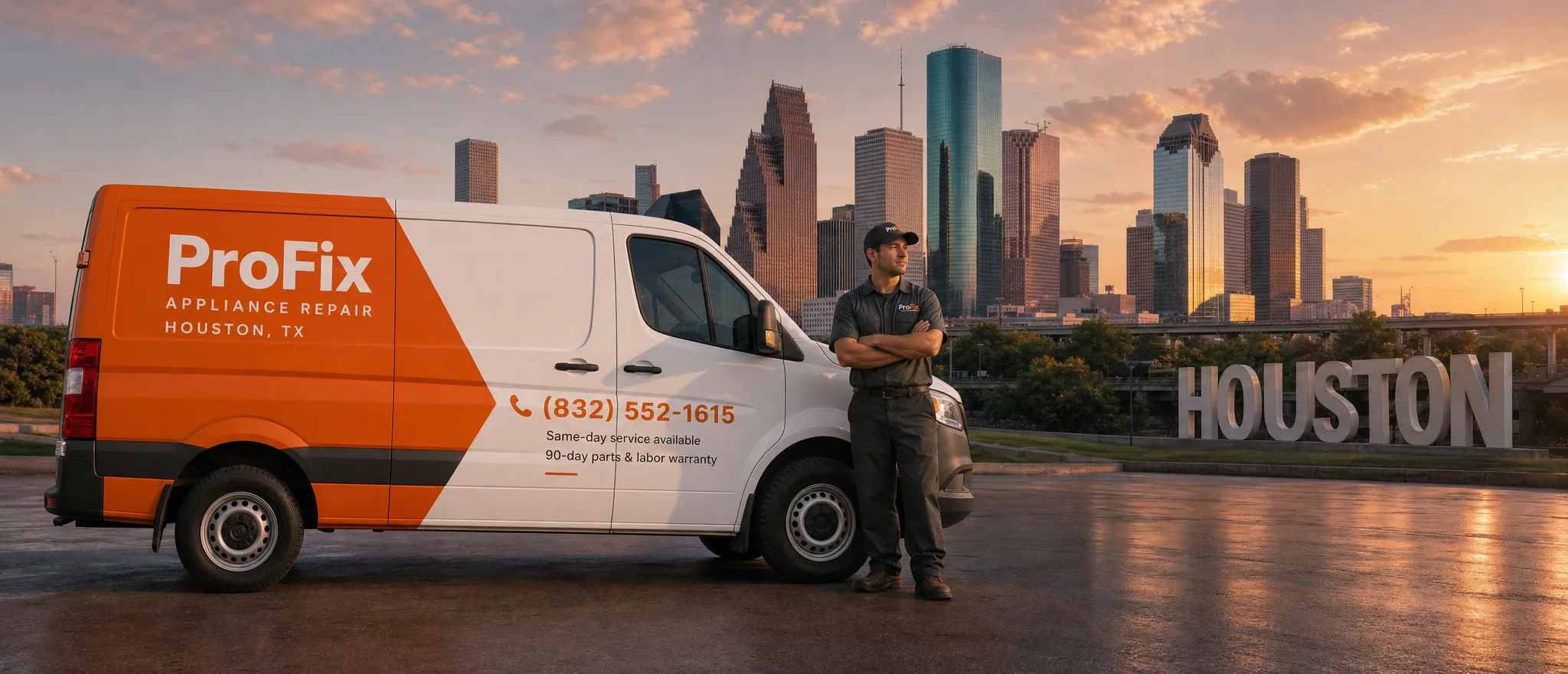
Wine Cooler Repair Near You — All Brands
Fast, reliable local Wine Cooler repair — certified neighborhood technicians, all brands, same-day available.
- Same-day & next-day appointments
- Certified, background-checked technicians
- 90-day parts & 30-day labor warranty on all repairs
- Upfront pricing — no hidden fees
- All major brands serviced
Available Mon–Sat 7am–8pm · Sun 9am–5pm
Schedule Your Repair
Service Type
What type of service do you need?
Or call us directly:
(832) 552-1615Brands We Service

















Your Neighborhood Repair Team — Fast, Local & Certified
Wine coolers maintain precise temperatures to protect valuable wine collections. Both compressor-based and thermoelectric models require specialist repair. We repair compressor-based and thermoelectric (Peltier) wine coolers and beverage centers from all brands.
Same-Day Service
Most repairs completed same day. Call before noon for best availability.
90-Day Parts & 30-Day Labor
All parts and labor backed by our 90-day parts & 30-day labor warranty. If it breaks, we return at no charge.
Upfront Pricing
We quote before we start. No surprises, no hidden fees — your price is locked in.
How It Works
Ready to schedule your repair?
ProFix Appliance Repair — trusted by thousands of homeowners. Same-day slots available.
Common Wine Cooler Problems We Fix
Not Cooling
The wine cooler is not maintaining the proper serving temperature range (45–65°F for wine).
Usual causes: Compressor failure (compressor-type coolers), Thermoelectric module (Peltier) failure (thermoelectric coolers), Condenser coils dirty, Evaporator fan failure.
Temperature Not Consistent
Temperature swings damage wine quality and indicate a control or cooling issue.
Usual causes: Faulty thermostat, Intermittent compressor cycling, Degraded thermoelectric module, Dirty condenser.
Making Strange Noise
Unusual noises from a wine cooler indicate fan, compressor, or vibration issues.
Usual causes: Failing compressor (compressor type), Fan motor wear, Vibration from improper leveling, Loose internal shelving.
Door Seal Issue
A leaking door seal causes temperature instability and condensation buildup.
Usual causes: Hardened or cracked gasket, Mold growth on gasket, Door alignment problem, Physical damage to gasket.
Compressor Issue
A failing compressor is the most serious wine cooler repair — but usually more cost-effective to repair than replace a premium unit.
Usual causes: Compressor wear, Refrigerant leak, Overheating from dirty coils, Electrical overload.
Display / Control Issue
A malfunctioning display prevents temperature adjustment and monitoring.
Usual causes: Control board failure, Touchpad damage, Power surge, Loose wiring connector.
Not Reaching Target Temperature
The wine cooler runs but cannot reach the set temperature, leaving wine warmer than desired.
Usual causes: Dirty condenser reducing heat rejection, Thermoelectric module losing efficiency, Door gasket worn allowing ambient heat infiltration, Unit placed in direct Houston summer sun or warm enclosed space.
Too Cold — Wine Freezing
The wine cooler is running too cold, risking freezing of wine or sparkling wine.
Usual causes: Temperature control set too low, Thermostat calibration drift, Temperature sensor failure reading too warm, Control board malfunction.
Compressor Not Running
In a compressor-type wine cooler, the compressor is not activating.
Usual causes: Start relay failure, Compressor motor winding failure, Thermal overload from dirty condenser coils, Control board not signaling compressor.
Thermoelectric Module Failure
In a Peltier (thermoelectric) wine cooler, the cooling module has failed and is no longer transferring heat.
Usual causes: Peltier module burned out — typical lifespan is 5–7 years, Poor heat sink contact reducing efficiency over time, Thermal paste dried out on hot side heat sink, Voltage fluctuation causing module damage.
Cooling Fan Not Working
The internal circulation fan is not running, causing warm spots and temperature stratification.
Usual causes: Fan motor failure, Fan blade jammed by debris, Wiring connection failure, Control board not activating fan.
Water Leaking from Wine Cooler
Water is dripping from inside the cooler or pooling below it.
Usual causes: Condensation from warm Houston air entering through worn door gasket, Defrost water not draining properly, Drain tube clogged causing overflow, Internal humidity causing condensation on bottles and dripping.
Excessive Condensation Inside
Water droplets or a film of condensation is forming on the interior walls or wine bottles.
Usual causes: Door gasket worn allowing humid Houston air to enter, Door opened frequently during Houston's summer humidity peak, Unit humidity control not managing high ambient humidity, Temperature set too low creating large temperature differential with Houston ambient.
Door Gasket Worn
The magnetic door seal on the wine cooler has deteriorated, allowing warm air infiltration.
Usual causes: Age-related rubber hardening, Houston humidity cycling causing gasket to swell and crack over time, Physical damage from objects, Chemical cleaning agent degrading the rubber.
Vibrating Excessively
The wine cooler vibrates more than normal, which can disturb wine sediment and affect wine quality.
Usual causes: Compressor vibration mounts worn, Fan blade slightly out of balance, Unit not level on floor, Compressor starting to fail and running roughly.
Noisy During Operation
The wine cooler produces excessive noise — buzzing, rattling, or grinding — during operation.
Usual causes: Fan blade hitting debris or ice, Compressor running loudly from worn mounts, Wine bottles touching each other and vibrating, Unit not level causing rattling.
Temperature Fluctuating
Temperature inside the wine cooler swings significantly rather than staying stable at the set point.
Usual causes: Door gasket worn allowing ambient temperature influence, Thermostat calibration off, Compressor short-cycling from dirty condenser coils, Unit in location with direct sun or heat vent nearby.
Display Not Working
The temperature display or control panel is blank or unresponsive.
Usual causes: Control board failure, Display component failure, Power supply issue, Loose wiring to display.
One Zone Not Cooling (Dual Zone)
In a dual-zone wine cooler, one zone maintains temperature while the other does not.
Usual causes: Zone damper failure not directing airflow, Zone thermostat for the failing zone failed, Evaporator frost blocking airflow to one zone, Control board zone circuit failure.
Interior Light Not Working
The light inside the wine cooler does not illuminate when the door is opened.
Usual causes: Burned-out LED module, Door switch failure, Wiring to light broken, Control board not sending power to light.
Wine Cooler Won't Turn On
The wine cooler shows no power — blank display, no sound, no response.
Usual causes: Tripped circuit breaker, Failed power cord, Control board failure, Thermal overload tripped from previous overheating.
Thermoelectric Efficiency Declining
A Peltier-type wine cooler is gradually losing its ability to maintain target temperature, even though the module still works.
Usual causes: Peltier module aging and losing efficiency (output declines with age), Thermal paste between module and heat sinks dried out, Heat sink fins clogged with dust reducing heat dissipation, Fan speed reduced from bearing wear — less cooling of hot side.
Compressor Vibration Affecting Wine Quality
A compressor-type wine cooler is vibrating enough to disturb wine sediment and affect aging.
Usual causes: Compressor mounting isolators worn, Unit not level on floor, Compressor starting to fail and running roughly, Refrigerant slugging in lines during startup.
LED Lighting Failed
The LED lighting inside the wine cooler has gone out.
Usual causes: LED strip or module burned out, LED driver component failure on control board, Wiring connection to LED strip broken, LED switch or door switch failed.
Temperature Display Reading Wrong
The displayed temperature does not match the actual temperature measured inside the wine cooler.
Usual causes: Temperature sensor drifted from calibration, Sensor placed in a location with uneven temperature, Control board display calibration off, Sensor probe damaged giving incorrect reading.
Not Cooling Below Ambient Temperature
The wine cooler temperature is at or near room temperature despite running — no cooling at all.
Usual causes: Compressor completely failed, Peltier module completely burned out, Refrigerant completely lost from leak, Fan failure with no heat rejection causing system to not cool at all.
Upper Zone Warmer Than Lower Zone
In a single-zone wine cooler, the upper bottles are noticeably warmer than the lower ones.
Usual causes: This is normal — heat rises, so upper zones in a cooler are naturally warmer, Fan circulation not reaching upper zone adequately, Upper zone air vent blocked by bottles placed too close to sides, Evaporator positioned at bottom — temperature gradient is inherent in some designs.
Door Difficult to Get Sealed Properly
The wine cooler door requires extra force to close and seal, or regularly falls slightly open.
Usual causes: Gasket not seating properly due to stiffness or deformation, Cooler not level — slight forward tilt causing door to fall open, Door hinge spring weak, Magnetic seal declining with age.
Interior Humidity Too Low — Corks Drying
The wine cooler humidity is too low, causing natural corks to dry out and potentially spoil wine.
Usual causes: Thermoelectric coolers tend to be drier than desired for wine storage, Door opened frequently allowing dry air in, Houston's air conditioning reducing ambient humidity below ideal wine storage levels, Cooler running continuously without adequate moisture source.
Cooler Not Reaching Wine Serving Temperature
The wine cooler set to 55°F (ideal red wine serving temperature) cannot get below 65°F.
Usual causes: Thermoelectric cooler inadequate for Houston summer (thermoelectric only works 30°F below ambient), Condenser coils dirty reducing compressor-type efficiency, Door gasket worn allowing warm air infiltration, Houston summer ambient (90–100°F) exceeding thermoelectric cooler's cooling capacity.
Cooler Running Louder Than When New
The wine cooler has become progressively louder over time.
Usual causes: Compressor mounting isolators worn — compressor vibration transmitted to case, Fan blade slowly becoming unbalanced from dust accumulation, Fan motor bearing wearing out, Cabinet resonating with an aging compressor's vibration.
Smart Wi-Fi Feature Not Connecting
A smart wine cooler's Wi-Fi connectivity has stopped working.
Usual causes: Wi-Fi module failure in the cooler's control board, Home router firmware update changing network settings, Network password changed and cooler not updated, 2.4 GHz vs 5 GHz network compatibility issue.
Floor Vibration Being Transmitted to Wine
Vibrations from the floor (foot traffic, HVAC system, nearby appliances) are being felt inside the wine cooler.
Usual causes: Cooler placed on hard floor without vibration isolation, Cooler feet directly on tile or hardwood transmitting vibration, Cooler near HVAC equipment producing constant vibration, Foot traffic above on two-story home.
Wine Cooler Door Hinge Failure
The wine cooler door hinge has failed, causing the door to sag or not close properly.
Usual causes: Hinge pin worn from repeated use, Hinge bracket cracked, Door weight exceeding hinge capacity when fully loaded with wine bottles, Physical impact damage.
Internal Fuse Blown
The wine cooler has stopped completely and the internal fuse has blown.
Usual causes: Power surge from Houston thunderstorm tripping internal fuse, Compressor drawing excess current and blowing fuse, Wiring fault causing short circuit, Component failure causing overcurrent event.
Cooler Set Up for Beer — Temperature Issues
The wine cooler is being used for beer storage and the temperature isn't appropriate.
Usual causes: Beer requires 35–50°F; wine coolers optimized for 45–65°F — may not reach beer-optimal range, Temperature control not accurate at low beer storage temperatures, Single zone can't serve both beer (cold) and red wine (room temp) simultaneously, Cooler sensor calibrated for wine temperature range not beer range.
Wine Quality Degrading in Cooler
Wine stored in the cooler is developing off-flavors or spoiling faster than expected.
Usual causes: Temperature instability exposing wine to repeated temperature swings, Vibration from a compressor-type cooler disturbing wine sediment, UV light exposure through the glass door in a sunny Houston room, Excessive humidity causing cork mold issues.
Dual-Zone Temperature Inconsistent
Both zones are set to different temperatures but both read approximately the same temperature.
Usual causes: Damper between zones failed in one position, Zone thermostat calibration issue, Both zones sharing one cooling system — inadequate at maintaining large temperature difference, Zone fan not directing air properly between zones.
Door Alarm Beeping
The wine cooler is beeping repeatedly, indicating the door is open or not properly sealed.
Usual causes: Door not fully closed — gasket edge caught on bottle, Door gasket not sealing and triggering the door sensor, Door sensor failure giving false 'door open' reading, Door alarm threshold set too sensitive.
Compressor Short Cycling
The wine cooler compressor starts and stops every few minutes instead of normal longer run cycles.
Usual causes: Condenser coils dirty in Houston's environment — coils need cleaning every 6 months, Cooler in a warm Houston room making compressor overwork, Refrigerant slightly low, Temperature sensor causing compressor to cycle too frequently.
Unit Performance Issues in Houston Climate
The wine cooler is underperforming compared to specifications, related to Houston's climate conditions.
Usual causes: Houston summer ambient temperatures (85–100°F indoors with AC off) stressing cooling capacity, High indoor humidity causing the unit to struggle more than in drier climates, Wine cooler placed in unconditioned garage in Houston — essentially impossible to maintain wine temps, Unit not sized for the thermal load in Houston's climate.
UV-Blocking Door Glass Damaged
The UV-blocking tinted glass door of the wine cooler has been damaged, exposing wine to harmful UV light.
Usual causes: Impact cracking the tempered UV-blocking glass, UV-blocking coating on glass chipping or peeling, Door glass replaced with non-UV-blocking glass by a previous repair, Physical impact damage to the tinted door panel.
Wine Has Excessive Sediment from Vibration
Fine wines are showing excessive sediment disturbance, possibly from cooler vibration.
Usual causes: Compressor vibration transmitted to wine bottles through shelving, Compressor mounting isolators worn, Cooler not level — vibration amplified, External floor vibration transmitted through cooler.
Thermostat Needs Replacement
The wine cooler thermostat has failed, causing the cooling system to run continuously or not run at all.
Usual causes: Thermostat contacts welded closed — compressor runs continuously, Thermostat contacts stuck open — compressor won't run, Bimetal element in thermostat fatigued from years of cycling, Age-related thermostat failure after 8–12 years.
Wine Cooler Shelves Sagging from Weight
The wire or wood shelves in the wine cooler are bowing or sagging from the weight of full wine bottles.
Usual causes: Shelves overloaded beyond their design weight — each shelf has a limit, Shelf support brackets too weak for the bottle count, Wood shelves absorbing humidity and losing rigidity, Wire shelves stretched from concentrated load.
Can't Reach Red Wine Temperature (60–65°F)
The wine cooler struggles to hold the warmer range needed for red wine service in Houston's climate.
Usual causes: Houston summer ambient of 85–100°F making the cooling differential very small for the upper temperature range, Thermoelectric cooler particularly challenged to hold 60°F when ambient is 80°F+, Cooling system running continuously without cycling off — indicates overcapacity issue, Door opened frequently allowing warm air to rapidly raise internal temperature.
Wine Cooler Tripping Breaker or GFCI
The wine cooler is tripping a circuit breaker or GFCI outlet, cutting power.
Usual causes: Compressor motor drawing excessive current on startup, Wine cooler on a GFCI circuit — compressor's electrical signature can nuisance-trip sensitive GFCI outlets, Internal wiring fault creating a ground fault, Compressor motor failing and pulling too much current.
Wine Cooler Door Frame Discolored or Stained
The door frame, handle, or exterior cabinet has developed discoloration or staining.
Usual causes: Condensation from Houston humidity collecting on the door frame and promoting oxidation, Cleaning chemicals reacting with the cabinet finish, Mold or mildew on the exterior from Houston's humid environment, Direct sun exposure UV-fading the exterior finish.
Wine Cooler Using Too Much Electricity
The wine cooler is using significantly more electricity than the energy guide rating suggests.
Usual causes: Door gasket worn allowing cold air to escape continuously, Condenser coils fouled making the compressor run much more than needed, Thermoelectric module losing efficiency with age, Houston summer ambient temperatures causing the unit to run much more than its energy rating reflects (energy ratings done at 70°F ambient).
Wine Cooler Placement Issues
The wine cooler is performing poorly because of where it has been placed in the home.
Usual causes: Placed in direct afternoon sun in a Houston home — can add 20–30°F to thermal load, Placed in an unconditioned garage — impossible in Houston summer, Insufficient clearance on sides and top for compressor-type coolers that exhaust hot air, Placed next to oven or dishwasher that generates heat during use.
Wood Shelves Developing Mold
The wood display shelves inside the wine cooler are developing mold or mildew.
Usual causes: Humidity inside the cooler combined with wood providing an organic surface for mold growth, Houston's high ambient humidity creating condensation inside the cooler when the door is opened, Wood shelves not properly sealed with a moisture-resistant finish, Airflow not reaching the shelves properly.
Old Wine Cooler — Repair vs. Replace Decision
A wine cooler is failing and the owner needs guidance on whether repair is economical given the unit's age.
Usual causes: Thermoelectric units typically last 5–7 years, Compressor wine coolers typically last 10–15 years, Repair cost relative to replacement cost, Availability of replacement parts for older or discontinued models.
Condensation on Exterior Cabinet
Moisture is forming on the outside of the wine cooler cabinet.
Usual causes: Houston's high summer humidity (80–95% RH) contacting the cooler's cold exterior surfaces, Anti-sweat heaters (if equipped) failed or insufficient for Houston's extreme humidity, Door opened frequently in peak Houston summer humidity, Cooler set to very cold temperature creating large temperature differential with humid room.
Wine Cooler Repair Across Greater Houston
Few appliances affect a household's daily routine as directly as a malfunctioning wine cooler, and our technicians throughout greater Houston approach every one of these calls with real diagnostic urgency. That's the standard every technician we send throughout our coverage area is trained to uphold, every single time. Genuinely, always.
Wine coolers maintain precise temperatures to protect valuable wine collections. Both compressor-based and thermoelectric models require specialist repair.
Houston's genuinely brutal summer heat and near-constant humidity put real, sustained stress on wine cooler components throughout our coverage area, and we've built our technician training specifically around recognizing how that climate accelerates certain failure patterns compared to drier parts of the country.
Whether a wine cooler is installed in a high-rise condominium near downtown or a single-family home out past Beltway 8, our technicians carry the same certified training and genuine parts inventory to every call throughout our coverage area.
We keep our technicians current on evolving smart-home and app-connectivity features increasingly common in modern wine cooler models, understanding that a growing share of Houston-area households now expect a technician to understand both the mechanical and digital side of a repair. We treat every wine cooler throughout our coverage area with the same level of certified care regardless of a household's specific neighborhood or property type, holding every technician to the identical standard on every visit. We've found that a genuine, patient explanation of exactly what failed inside a wine cooler matters as much to a lot of our customers as the repair itself, and we make a point of walking through that explanation in plain language before ever reaching for a tool.
Common Wine Cooler Issues We Fix
The most common wine cooler issues our technicians diagnose throughout greater Houston include not cooling, temperature not consistent, making strange noise, door seal issue, compressor issue, and display / control issue, and we carry the specific diagnostic tools and OEM parts to resolve each of these quickly. We remain proud to bring that same certified standard to every wine cooler repair across greater Houston, without exception.
When a wine cooler throughout our coverage area comes in for not cooling, the root cause is most often compressor failure (compressor-type coolers), thermoelectric module (peltier) failure (thermoelectric coolers), condenser coils dirty, evaporator fan failure, and our diagnostic process is built specifically to isolate which of these is actually responsible rather than guessing. We remain proud to bring that same certified standard to every wine cooler repair across greater Houston, without exception.
The sheer diversity of Houston's population means our technicians regularly service wine cooler units used in genuinely different ways depending on a household's specific cooking habits and daily routines, and we've made a real point of understanding how that variety affects wear patterns.
We keep our technicians certified across wine cooler models both new and legacy, understanding that a household near the Heights or in Bellaire might be running a unit a decade or more older than one in a brand-new Katy subdivision.
Temperature Not Consistent is another genuinely common wine cooler complaint we see throughout our coverage area, and the underlying cause is most often faulty thermostat, intermittent compressor cycling, degraded thermoelectric module, dirty condenser. We calibrate the thermostat, test cooling system consistency, and clean condensers to restore stable temperature.
We train every technician on the specific safety disconnection procedures required before any wine cooler diagnostic work begins, understanding that a rushed shortcut on a gas or high-voltage unit is never worth the risk to a household. We keep our parts inventory for wine cooler repairs restocked on a rolling basis specifically calibrated to what we've actually seen fail throughout our Houston-area coverage territory over recent months.
Honest Wine Cooler Repair Pricing
We lead every wine cooler repair call throughout our coverage area with a clear, upfront cost estimate, typically in the $120–$380 range and usually completed within 1–2 hours, and we provide honest guidance on repair-versus-replace decisions.
Every wine cooler repair we complete carries our full standard 90-day parts and 30-day labor warranty, and we stand behind that promise fully across every community throughout greater Houston.
We remain mindful of how directly a Houston summer raises the stakes on any wine cooler repair involving refrigeration, since a slow diagnosis during a 100-degree stretch can mean real, avoidable loss for a family already managing a tight budget. Genuinely, always. We remain proud to bring that same certified standard to every wine cooler repair across greater Houston, without exception.
We also regularly diagnose making strange noise on wine cooler units throughout greater Houston, typically traced back to failing compressor (compressor type), fan motor wear, vibration from improper leveling, loose internal shelving, and our technicians carry the specific parts needed to resolve it in a single visit whenever possible.
Houston's genuinely competitive real estate market means a lot of households throughout our coverage area are working against a tight closing or move-in timeline, and we've built our wine cooler repair scheduling to accommodate that same urgency.
A Trusted Name for Wine Cooler Repair
Houston's genuinely enormous energy-sector and medical-center workforce, many working demanding shift schedules, has shaped how we think about wine cooler repair scheduling, since a rigid appointment window simply doesn't work for a meaningful share of the households we serve.
Households throughout our Houston-area coverage territory have called us back for wine cooler repairs across multiple years, and we take real pride in earning that kind of repeat trust.
Appliance downtime hits differently in a household managing a demanding energy-sector or medical-center work schedule, and we've built our wine cooler repair scheduling specifically around fitting into those genuinely tight windows.
We've noticed that wine cooler units throughout our coverage area tend to fail in genuinely predictable seasonal patterns, and we adjust our own parts stocking and technician scheduling to stay ahead of those patterns rather than reacting after the fact. Coastal humidity and the region's genuinely heavy annual rainfall can accelerate corrosion on certain wine cooler components over time, particularly in homes closer to the Gulf, and our technicians know to inspect those specific points more carefully. We remain proud to bring that same certified standard to every wine cooler repair across greater Houston, without exception.
Ready to Fix Your Wine Cooler
We keep emergency scheduling flexible for wine cooler failures throughout our coverage area, understanding how directly this specific appliance affects a household's daily routine.
We remain genuinely committed to bringing that same certified standard to every wine cooler repair throughout our Houston-area coverage territory, call after call, for as long as this community keeps trusting us with it. That's the standard every technician we send throughout our coverage area is trained to uphold, every single time.
Multi-generational households are genuinely common throughout many of Houston's established neighborhoods, and we've found that a wine cooler in one of these homes often gets used more intensively than average, a real factor we account for when diagnosing a specific failure pattern. A genuinely large share of the wine cooler calls we handle throughout our coverage area involve a unit that's still well within its useful life but has developed a single specific fault, and we consider correctly diagnosing and fixing that one component, rather than recommending a wholesale replacement, part of doing this job honestly.
Figures reflect ProFix Houston's typical service pattern for Wine Cooler repair across Harris County.
Wine Cooler Brands We Repair
Still have questions?
Our team is ready to help — same-day service available.