
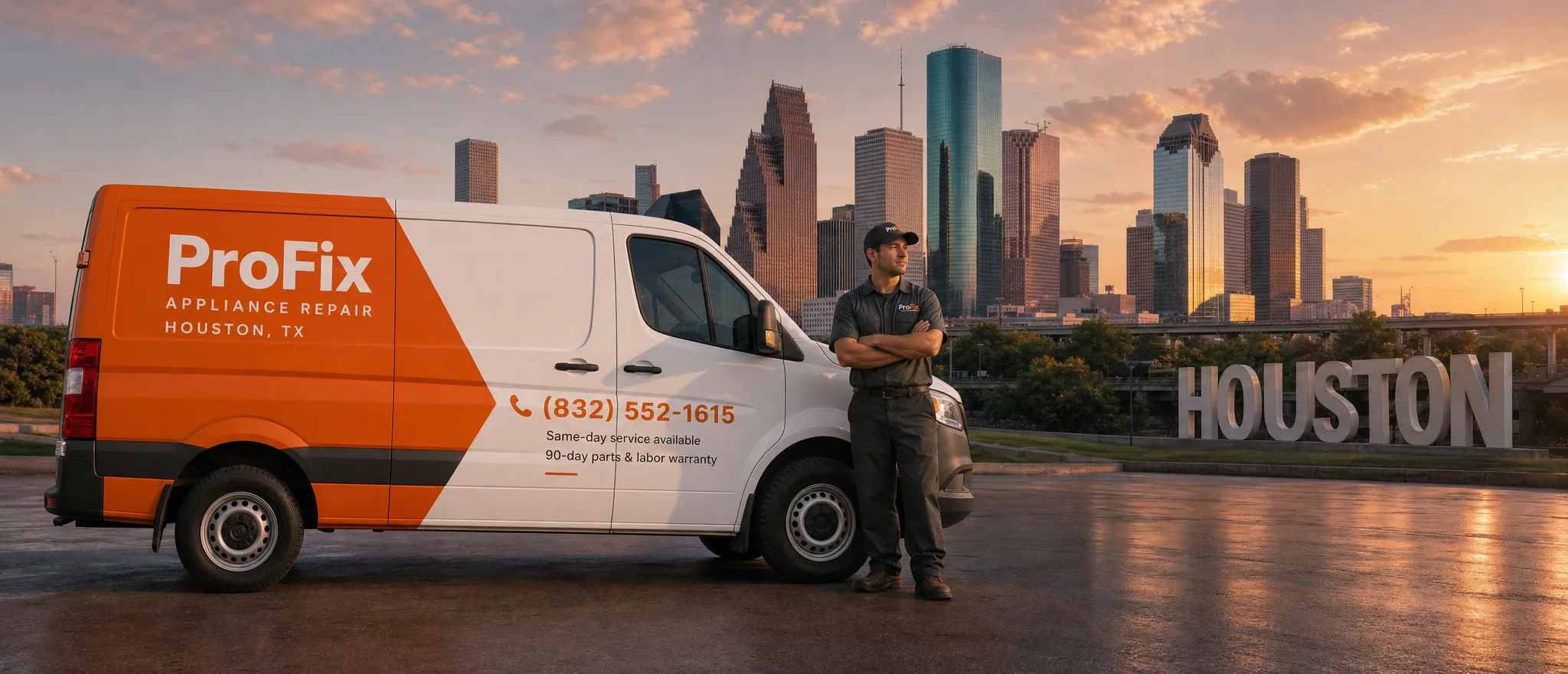

Wolf Range Repair Near You — All Brands Serviced
Local Wolf technicians ready to fix your Range near you. Same-day appointments available.
- Same-day & next-day appointments
- Certified, background-checked technicians
- 90-day parts & 30-day labor warranty on all repairs
- Upfront pricing — no hidden fees
- All major brands serviced
Available Mon–Sat 7am–8pm · Sun 9am–5pm
Schedule Your Repair
Service Type
What type of service do you need?
Or call us directly:
(832) 552-1615Brands We Service






























Your Neighborhood Repair Team — Fast, Local & Certified
Wolf manufactures premium cooking equipment known for precise temperature control and durability. Complex dual-stacked burner systems require specialist repair. ProFix Appliance Repair repairs Wolf ranges across greater Houston with genuine OEM parts and a 90-day parts & 30-day labor warranty.
Same-Day Service
Most repairs completed same day. Call before noon for best availability.
90-Day Parts & 30-Day Labor
All parts and labor backed by our 90-day parts & 30-day labor warranty. If it breaks, we return at no charge.
Upfront Pricing
We quote before we start. No surprises, no hidden fees — your price is locked in.
How It Works
Related Services
More repairs we specialize in
Ready to schedule your repair?
ProFix Appliance Repair — trusted by thousands of homeowners. Same-day slots available.
About Wolf Range Repair
Repairing a Wolf range means diagnosing burner ignition, oven cavity heating elements, control board faults, and door seal issues across both the cooktop and oven sections of the unit. Wolf specializes exclusively in cooking appliances — ranges, ovens, cooktops — using dual-stacked burners and a red-knob signature design; refrigeration for the same households is typically handled by its sister brand Sub-Zero, and Wolf does not make laundry, dishwashers, or refrigerators. That combination is what lets our technicians pinpoint the actual cause instead of guessing.
Certified Wolf Repair Expertise
Wolf-trained technicians experienced with their dual-stacked sealed burner systems, French top ranges, and built-in ovens. Our technicians hold themselves to that standard on every single Wolf visit throughout our coverage area.
Wolf units throughout our coverage area most commonly come in for dual-stack igniter failure, thermostat issues, control panel problems, simmer plate malfunction, and convection motor failure, and we keep the specific diagnostic tools and OEM parts on hand to resolve each of these quickly rather than guessing. We think that consistency is exactly what a Houston-area household should expect from any vendor it trusts.
Hard water is a real, documented issue across large parts of the greater Houston area, and we've seen firsthand how mineral buildup affects ice makers, water dispensers, and dishwasher components over time, building that awareness directly into how we diagnose and explain certain recurring failures.
Whether a Wolf appliance is installed in a high-rise condominium near downtown or a single-family home out past Beltway 8, our technicians carry the same certified training and the same genuine parts inventory to every call throughout our coverage area.
Multi-generational households are genuinely common throughout many of Houston's established neighborhoods, and we've found that a Wolf appliance in one of these homes often gets used more intensively than average, a real factor we account for when diagnosing a specific failure pattern.
Our dispatch team keeps a running record of which specific Wolf models show up most often across each of our Houston-area service territories, and we use that real pattern data to keep the right parts already loaded on our trucks rather than making a household wait on a special order.
Known Wolf Range Failure Points
- Dual-stacked burner or red-knob control faults
- Burner ignition problems
- Oven cavity heating element failures
- Control board faults
Range Problems We Fix on Wolf Models
Burner Not Working
Range burner failures are common in Houston homes where high-frequency cooking plus humidity create the perfect environment for igniter corrosion and grease-blocked ports.
Usual causes: Clogged burner orifice, Failed igniter electrode, Damaged surface element block, Tripped internal fuse.
Range Oven Door Hinge Failure
The oven door hinges are broken or worn, causing the door to sag or not stay in any position.
Usual causes: Hinge arm fractured from stress, Hinge spring broken, Hinge cam worn, Self-clean temperature causing thermal stress to hinges.
Gas Smell from Range
Gas odor is detectable near the range when burners are off or during use.
Usual causes: Supply line connection loose at range, Burner valve not fully sealing in off position, Gas valve O-ring worn, Igniter releasing gas before lighting.
Surface Element Switch Failure
The control switch for a surface element is stuck or allows only one heat setting instead of variable control.
Usual causes: Infinite switch contacts worn from years of use, Internal cam mechanism in switch broken, Wiring terminal burned at switch, Switch overheated and contacts welded at one position.
Range Level Adjustment Needed
The range top surface is visibly tilted, making cooking on level surfaces impossible.
Usual causes: Adjustable leveling legs not at proper height, Floor uneven — front and back leg heights need to compensate, One leveling leg seized or broken, Anti-tip bracket preventing full leg extension.
Range Hood Issues Over Range
The range hood installed above the range is not performing adequately.
Usual causes: Hood CFM insufficient for the range's BTU output, Duct diameter too small for hood CFM rating, Duct run too long with too many bends reducing effective airflow, Hood filter extremely clogged with grease.
Control Knob Not Clicking Into Positions
The burner control knob doesn't have firm detent positions and feels loose or turns without resistance.
Usual causes: Infinite switch detent mechanism worn, Knob spring inside the switch worn, Knob hub cracked from thermal stress, Knob not properly engaged on the D-shaft.
All Range Burners Clicking Simultaneously
When any range knob is turned, all burner igniters click simultaneously — even unintended burners.
Usual causes: This is normal for most gas ranges — all electrodes are on one igniter module, One moisture-laden electrode causing extra clicking from all, Failed igniter module producing excess clicking on all channels, Shorted igniter switch causing module to activate continuously.
Range Oven Light Not Working
The interior light in the oven portion of the range does not illuminate.
Usual causes: Oven bulb burned out (requires appliance-rated high-temperature bulb), Door switch for oven light failed, Light socket corroded, Wiring to oven light failed.
Range Self-Clean Error Code
The range displays an error code during or after a self-clean cycle.
Usual causes: Door lock motor failure during the lock/unlock sequence, Temperature sensor reading outside the expected self-clean temperature range, Thermal fuse blown from the extreme self-clean temperature, Control board self-clean relay failure.
Bake Element Not Fully Seated
The bake element is not properly seated against the oven back wall, potentially arcing or not heating evenly.
Usual causes: Element not pushed fully into the terminal sockets, Terminal sockets worn and not gripping element terminals, Previous service where element was replaced without fully seating, Thermal expansion causing element to shift over time.
Gap Between Slide-In Range and Countertop
A slide-in range has gaps between the cooktop and the adjacent countertop, creating a food and grease trap.
Usual causes: Range not pushed fully into cabinet opening, Countertop has settled unevenly, Range leveling feet adjusted unevenly leaving a gap, Original countertop removed and replaced with a slightly different depth.